Divisions
Seven self-perform divisions that share a dispatch board, one safety program, and one operator-qualification matrix. Most of our work pulls at least three of them onto the same job.
- Divisions
- 07
- Crews
- 48
- Self-performed
- 84%
- Bonding, single
- $45M
01 Broadband & Fiber
Broadband & Fiber
We build outside plant end to end: pole applications and make-ready through strand, lash, placement, splice, test, and turn-up. Our splicers carry their own fusion sets and OTDRs, and they close out the job with the trace — not a promise to send it later.
Underground is the same crew list. Directional bore, plow, trench, or rock saw depending on what the ground gives us, with vaults, handholes, and pedestals set to the owner's standard and restored to grade.
For grant-funded builds — BEAD, RDOF, state broadband offices — we deliver the passing-level documentation and photo evidence the program requires as part of the build, because retrofitting that record after the fact never works.
Scope of work
- Pole applications & make-ready engineering
- Pole replacement & transfers
- Strand, lash & overlash
- ADSS placement
- Directional bore & plow
- Vault, handhole & cabinet setting
- Fusion splicing & termination
- OTDR & power meter testing
- FTTH drops & ONT install
- MDU riser & in-building
- Hut, node & cabinet integration
- Emergency fiber restoration
| Capability | Capacity |
|---|---|
| Aerial crews | 14 |
| Underground crews | 11 |
| Splice & test technicians | 22 |
| Typical aerial production | 4,000 ft / day |
| Typical bore production | 900 ft / day |
| Restoration turnaround | ≤ 4 hrs on call |
02 Power Delivery
Power Delivery
Distribution work on blanket and unit-price agreements: new construction, pole change-outs, reconductoring, URD conversions, transformer and switchgear setting, and secondary services. Our line crews work energized to 15kV under a qualified-worker program with annual re-certification.
Storm is not a side business. We hold pre-positioned mutual-aid agreements and can put twelve crews on the road within twelve hours of a call, with fuel, lodging, and logistics handled by our own storm coordinator so the host utility does not have to manage us.
On the civil side we self-perform substation grading, foundations, grounding grids, duct banks, and control building pads — which keeps the schedule in one place when the equipment delivery date moves.
Scope of work
- Overhead distribution to 15kV
- Underground residential distribution
- OH-to-UG conversions
- Pole setting & change-out
- Reconductoring
- Transformer & switchgear setting
- Secondary & service drops
- Street & area lighting
- Substation civil & grounding
- Duct bank & manhole systems
- EV charging infrastructure
- Storm & outage restoration
Mobilization commitment
Twelve crews on the road within twelve hours of a mutual-aid call. Self-sufficient for the first seventy-two hours: fuel, water, lodging, and mechanics travel with the convoy.
03 Gas & Pipeline
Gas & Pipeline
Distribution mains and services in PE and steel, meter set installation and relocation, and the cast iron and bare steel replacement programs that most LDCs are running against a regulatory clock. Every task that touches a covered facility is performed by an operator-qualified employee, and the OQ record travels with the crew on the tablet.
Integrity work — excavation and exposure for ILI anomaly digs, coating repair, recoating, composite sleeve installation, and backfill under an inspector's hold points, with NDT coordination handled by us.
We also self-perform cathodic protection: anode bed installation, test station setting, rectifier installation, and annual survey.
Scope of work
- PE & steel distribution mains
- Service lines & meter sets
- Cast iron / bare steel replacement
- Keyhole & vacuum excavation
- Tie-ins & stopples
- Station & regulator piping
- ILI anomaly & integrity digs
- Coating & recoating
- Cathodic protection systems
- Leak survey support
- Purging & commissioning
| Qualification | Status |
|---|---|
| Operator qualification (ASME B31Q) | All covered-task personnel |
| DOT 192 subpart N compliance | Program audited annually |
| Fusion technicians | 64 qualified |
| API 1104 welders | 18 on roster |
| ISNetworld / Avetta | Active, grade A |
04 Water & Wastewater
Water & Wastewater
Water main installation and replacement in ductile iron, PVC, and HDPE, including hot taps, line stops, valve and hydrant setting, service transfers, and the pressure, chlorination, and bacteriological testing that has to pass before anybody gets water back.
On the wastewater side we install gravity sewer and force main, rehabilitate existing collection systems with cured-in-place lining and manhole coating, and build lift stations complete with wet well, piping, and controls.
Inflow-and-infiltration programs get the full sequence: flow monitoring, smoke and dye testing, CCTV inspection with NASSCO-coded reporting, then targeted rehabilitation ranked by return on the dollar.
Scope of work — water
- DI, PVC & HDPE main
- Directional bore & pipe bursting
- Hot taps & line stops
- Valve, hydrant & vault setting
- Service transfers
- Pressure, chlorination & bac-t testing
- Meter replacement programs
Scope of work — wastewater
- Gravity sewer & force main
- CIPP lining
- Manhole rehabilitation & coating
- Lift station construction
- Bypass pumping
- CCTV & NASSCO coding
- Smoke & dye testing
- I&I reduction programs
05 Heavy Civil & HDD
Heavy Civil & HDD
This is the division the other five call when the ground says no. Fourteen directional drills from 20,000 to 330,000 pounds of pullback, rock trenchers, bore-and-jack, and a mud recycling spread that keeps the crossing clean and the neighbors calm.
Crossings are engineered, not attempted. Every bore over 300 feet or under a sensitive feature gets a designed profile, a calculated pullback load, a frac-out contingency plan on site, and a bore log kept in real time. Inadvertent returns are a design failure, so we design against them.
We finish what we open: compaction testing, pavement replacement to DOT spec, curb and sidewalk, seed and straw or sod, and a punch walk with the inspector before we demobilize.
Scope of work
- Horizontal directional drilling to 24"
- Rock trenching & sawing
- Bore & jack, auger bore
- Road, rail & waterway crossings
- Vacuum & hydro excavation
- Open cut & shoring
- Duct bank & conduit systems
- Mud recycling & disposal
- Pavement & concrete restoration
- Erosion control & seeding
| Class | Pullback | Units |
|---|---|---|
| Compact / urban | 20,000 lb | 6 |
| Midsize | 40–100,000 lb | 5 |
| Maxi | 150–330,000 lb | 3 |
| Rock saw / trencher | — | 9 |
| Vacuum excavator | — | 17 |
06 Data Centers — Hyperscale
Data Centers — Hyperscale
White is the locate colour for a route nobody has dug yet. That is every hyperscale campus before we get there — a graded pad, a property line, and an energization date somebody has already promised a tenant.
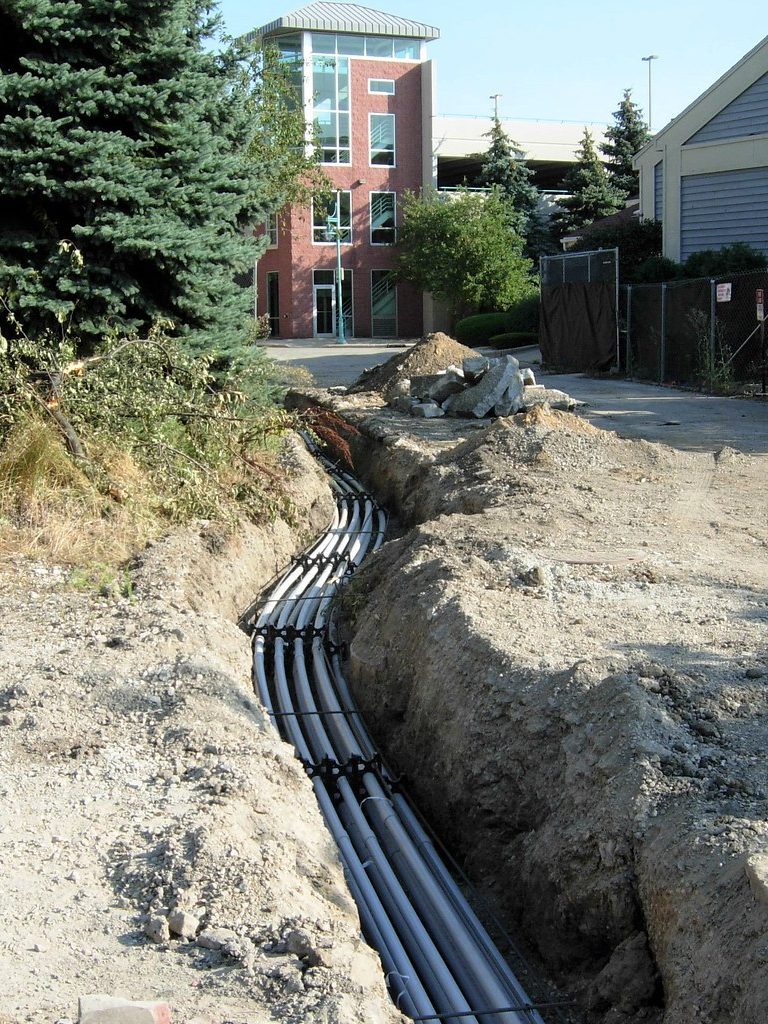
Our scope starts at the utility service entrance and stops at the building. We are not the GC and we are not the electrical contractor inside the white space. We are the campus underground: medium-voltage duct bank and precast manholes out to the switchgear pads, generator yard feeders and double-wall fuel piping, the fused chilled water loop, the site fire main, and the two physically diverse carrier entrances that land in the meet-me room.
Speed to power is not a slogan on this work, it is the schedule. Our duct bank sits on the critical path between the utility interconnect and the first switchgear pad, and it has to be poured, proofed, and surveyed before the cable pull is released — which has to finish before commissioning can start. We sequence against the switchgear delivery date, not the shell.
Diversity you can actually defend. Two entrance paths, physically separated by a surveyed distance for their entire run, each with its own handhole chain and its own record drawing. The whole point is that one careless excavator cannot take both. We know precisely how that failure happens, because preventing it is Division 07's day job.
Scope of work
- Medium-voltage duct bank, concrete-encased
- Precast manholes, handholes & pull boxes
- MV cable pulling & terminations
- Switchgear & transformer pads
- Generator yard feeders & control conduit
- Double-wall fuel oil piping & day tank interconnect
- Fused HDPE chilled & condenser water
- Site fire loop, hydrants, PIVs & backflow
- Domestic water & site sewer
- Ground ring & lightning protection grounding
- Diverse A/B carrier entrances & innerduct to the MMR
- Campus interconnect ring
- Temporary construction power
- SWPPP, grading & restoration
- Typical MV package
- 34.5kV or 13.8kV feeders in concrete-encased, red-dyed duct bank. Precast manholes on roughly 400-foot centers, every duct mandrel-proofed with a pull string left in.
- Entrance diversity
- Two paths, separated for the full run, each with its own handhole chain, conduit count, and record drawing. The separation distance is surveyed and stated — not asserted in a submittal.
- Mechanical
- HDPE DR-11 chilled and condenser water, butt-fused with recorded fusion data logs, hydrostatically tested before backfill.
- Sequencing
- Built backward from the energization milestone and the switchgear delivery date. Duct bank is surveyed and closed out before the cable pull is released.
- Records
- Every run captured with survey-grade GNSS in the open trench, delivered in the owner's CAD and GIS standard inside ten business days.
- Who we work for
- Developers and their EPC or design-build GC, usually as a direct site-utilities trade contract rather than a sub-tier.
07 Survey, SUE & Damage Prevention
Survey, SUE & Damage Prevention
The division that decides whether the other five have a good day. Route survey and topographic mapping, subsurface utility engineering to ASCE 38 quality levels D through A, private locating, potholing, permitting, and GIS as-built delivery.
We keep this in house on purpose. When the locate crew and the bore crew answer to the same superintendent, the conflict gets marked, potholed, and drawn before the drill arrives instead of getting discovered by the drill.
As-builts are captured with survey-grade GNSS at the time of installation — open trench, not from memory — and delivered in the owner's schema, whether that is Esri, a landbase CAD standard, or a flat file the operator can actually load.
Scope of work
- Route & topographic survey
- Subsurface utility engineering QL-D through QL-A
- Private utility locating
- Vacuum potholing & test holes
- 811 ticket management
- DOT, county & railroad permitting
- Environmental & erosion permitting
- Traffic control planning
- GPS as-built capture
- GIS data delivery & QA
- QL-D
- Records research. Existing plans, one-call records, and operator maps compiled.
- QL-C
- Surface survey of visible features — valves, pedestals, manholes — correlated to records.
- QL-B
- Designating. Geophysical location of the horizontal position of existing facilities across the whole corridor.
- QL-A
- Locating. Exposure and survey of the actual facility — size, material, condition, and elevation to the hundredth.
08 Common questions
What owners usually ask first.
How much of the work do you actually self-perform?
Do you take unit-price master service agreements?
What is your bonding capacity?
Can you work in an active right-of-way with other contractors?
How fast can you mobilize for emergency work?
09 Next step
Bring us the hard part of the route.
The crossing nobody wants to price, the block with five existing utilities, the pole line that needs make-ready yesterday. That is the work we are built for.
Prequalification package
Insurance certificates, EMR letter, safety statistics, bonding letter, OQ and certification matrix, equipment schedule, and three owner references — sent as one package within two business days of request.